MO Bill Watch
Every bill filed in the 2026 Missouri session, tracked on one site, and built solo in 36 hours.
- My role
- All of it, alone: the idea, the data model, the build, the launch, the upkeep.
- When
- Blank screen to live domain in 36 hours. Live since July 26, 2026.
- Stack
- Static site on Vercel, accounts and watchlists on Clerk and Upstash Redis, two hermetic ingest scripts.
- Team, funding, vendor, CMS
- None.
- Cost to run
- About the price of the domain.
- Outcome
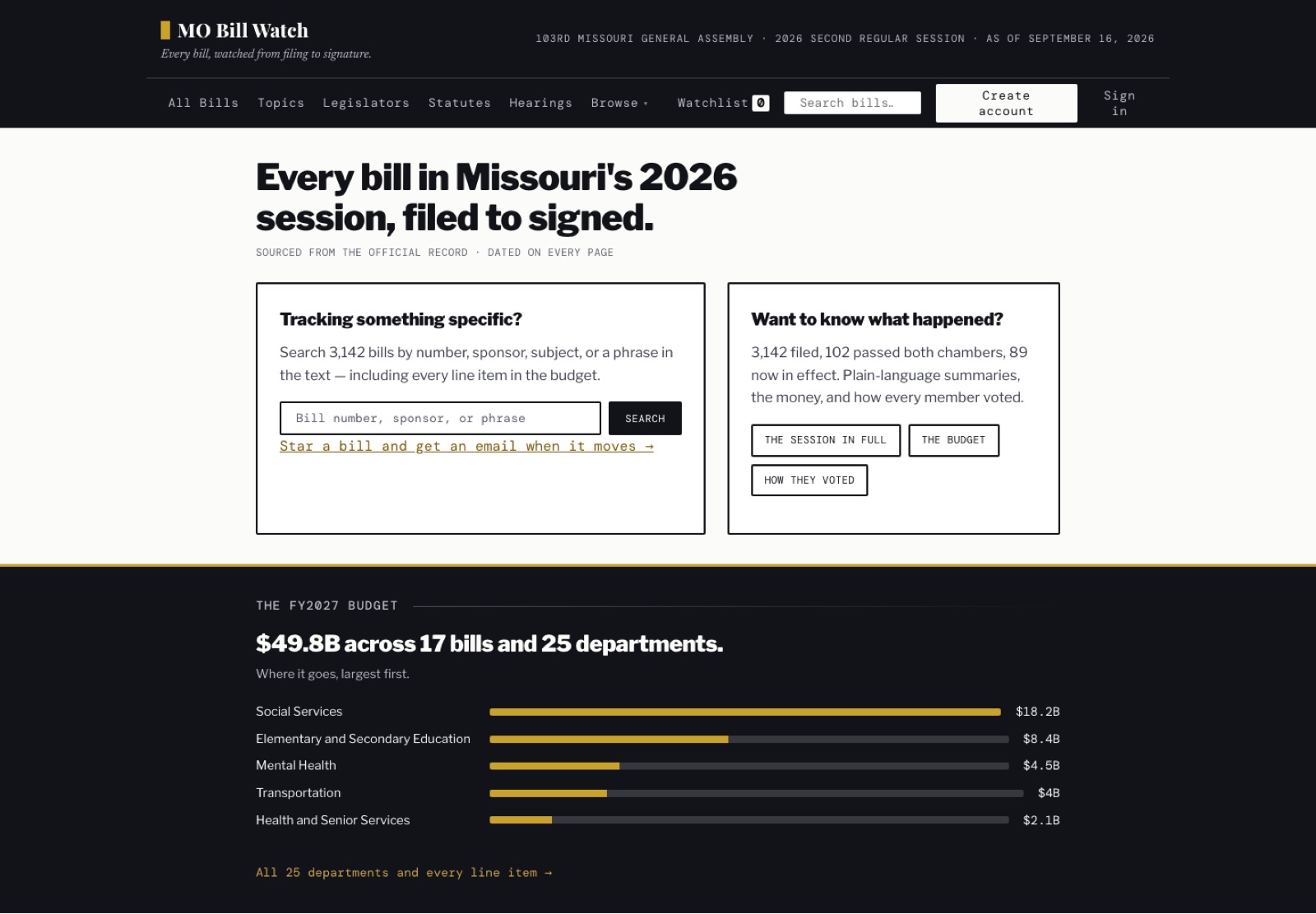
- 3,403 pages covering all 3,142 bills, with plain-language summaries for the 102 that became law.
I read bills for a living once, as a legislative budget analyst, so I know exactly where the official record fails you. Bills are hard to track: the real work isn't watching a status line, it's reviewing what changed from version to version, the substitute that swaps out the whole text, the new statutes quietly added along the way. And the same statute can be written into several bills at once, so following one bill never means you've seen the change coming. Bills are hard to understand: they're written as instructions for amending statute, not as an explanation of what they'd actually do. The people who need that picture (lobbyists, associations, reporters, citizens) rebuild it by hand, and everyone else goes without it.
Treat the whole session as data. Every bill gets a page. Every sponsor, every topic, and the shape of the session itself: how many bills go in, how few come out. Say what a bill does in plain language, because the bill text won't. Then a watchlist so a reader can follow the ten bills they care about instead of scanning three thousand.
3,403 pages: a page for every one of the 3,142 bills filed in 2026, including each of the 3,040 that died, plus 191 sponsor pages, 17 topic pages, and a live visualization of the session's attrition. Plain-language summaries for the 102 that became law. Accounts and watchlist sync. Two ingest scripts, both hermetic, so a slow upstream can never break the site.
AI wrote most of the code and architected the database, which is why 36 hours was enough. What it couldn't do was decide what was worth building. Knowing that the real pain is version-to-version review, that the same statute hides in several bills at once, that a summary has to say what a bill does and not what it amends: that came from years of reading bills for a living. Speed without a clear sense of purpose just means you'll ship the wrong thing faster than ever before.
The site factory I built for exactly this (a manifest, a scaffold, a QA gate, a launch packet) turned a niche I know cold into a live product before the week was out. That's the whole argument for the AI moment in one build.
If you're sitting on an idea, waiting until it's ready, I get it. I spent years learning that ready is a moving target, and the only thing that actually moves it is doing the thing. That's the Growth Strategy work: find the opening, then build enough of it to know.